
Screen printing and DTG both put ink on a t-shirt, but they get there in opposite ways. One is built for repeating a simple design many times. The other is built for printing a complex design a few times. Knowing how each works makes the choice easy.
How screen printing works
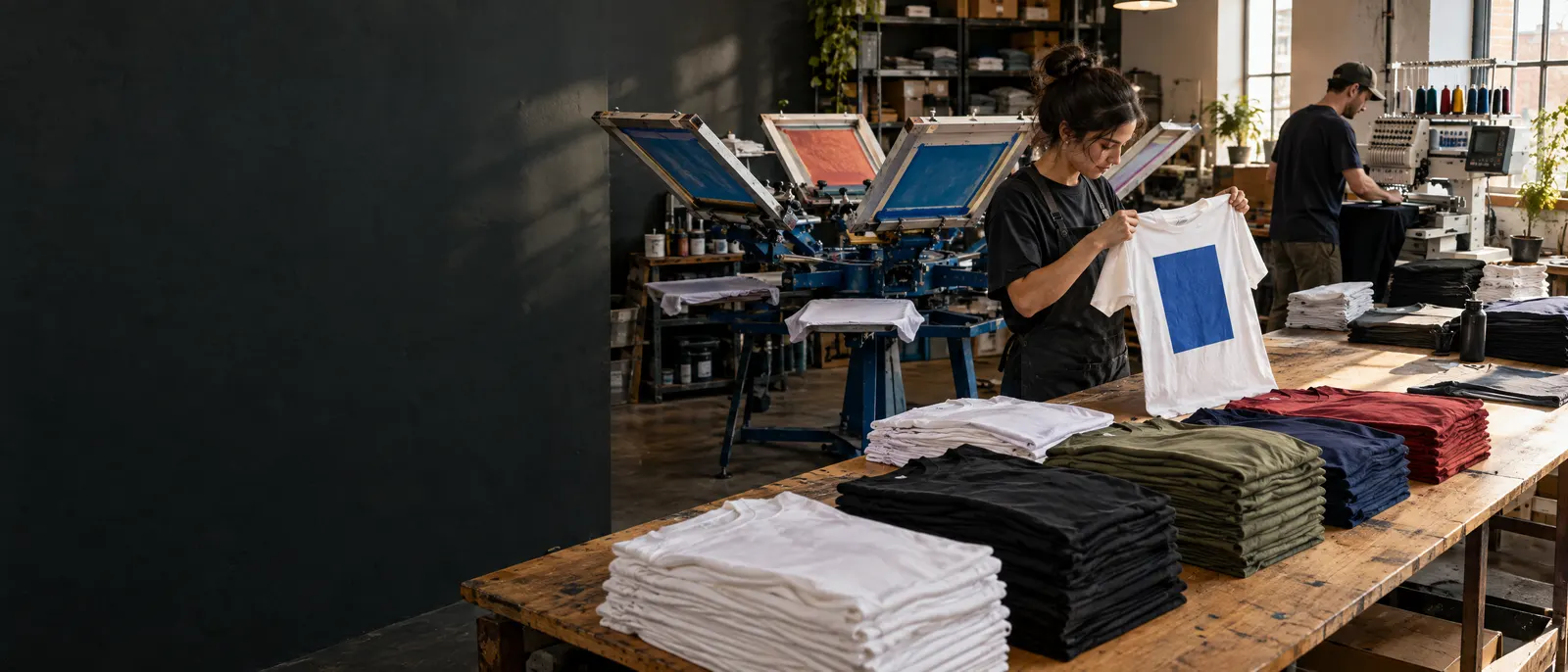
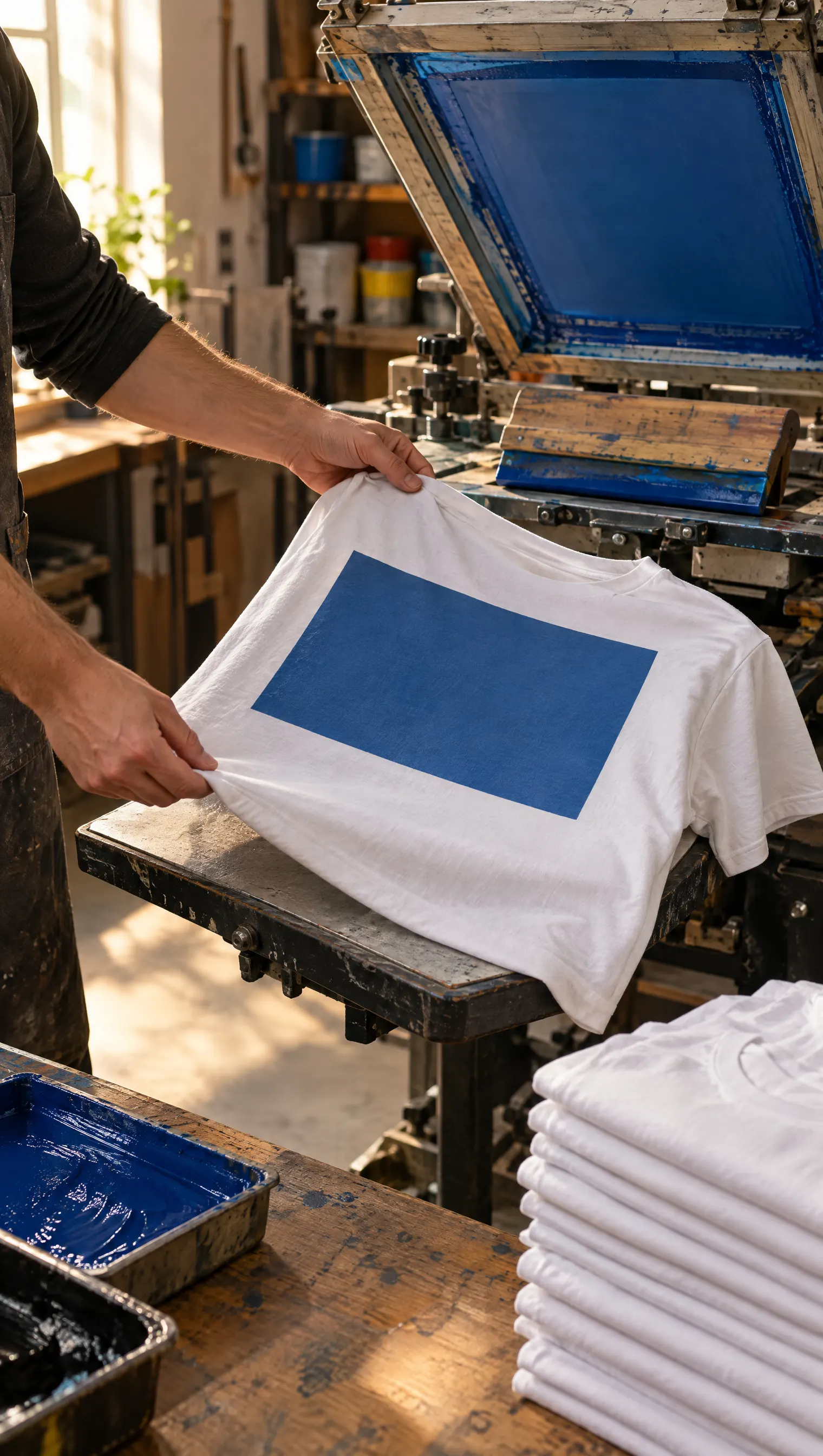
A screen is a fine mesh stretched on a frame. The design is turned into a stencil on the mesh: ink passes through the open areas and is blocked everywhere else. The screen is laid on the shirt and ink is pulled across it with a squeegee, pressing it through the stencil onto the cloth. The ink is then cured with heat so it sets.
Each colour in the design needs its own screen, printed one after another and lined up exactly. A three-colour logo is three screens and three passes.
The work is in the setup: making the screens, mixing the inks, lining them up. Once that is done, each shirt takes seconds.
How DTG works
DTG stands for direct to garment. It is an inkjet printer built for clothing. The shirt is laid flat on a platen, and the printer sprays water-based ink straight into the fibres, building the full design in one pass, every colour at once.
On dark shirts, the garment is pretreated and a white ink layer is printed first, so the colours sit on white and stay bright. On white and light shirts, the colour goes straight on.
There is almost no setup. The design is sent from a computer, and the first shirt costs about as much time as the hundredth.
Run size
This is the biggest difference.
- Screen printing has a fixed setup cost for each colour. On a large run, that cost is spread over many shirts and the price per piece falls a long way. On a small run, a few shirts carry it all.
- DTG has little setup, so the price per piece stays about the same whether you order five or fifty. It does not fall much on very large runs either, because every shirt takes the same printing time.
So: small runs lean to DTG, large runs to screen printing. Where exactly the line falls depends on the design, which is why it is priced per piece on a quote.
Colour count
- Screen printing is priced by colour. A one or two colour design is where it is at its best. Each extra colour adds a screen and a pass. Gradients and photographs are possible with halftones, but they need skill and more screens.
- DTG does not care how many colours you use. A photograph, a gradient or a twelve-colour illustration costs the same to print as a single colour.
The garment
- Screen printing works on cotton, blends and polyester, light and dark, with the right ink for each.
- DTG works best on cotton, where the ink soaks into the fibre. On polyester and high-polyester blends the colours are weaker. For polyester sportswear, sublimation is usually the better choice; see sublimation printing.
Feel and look
- Screen printing lays down a layer of ink. Bold, flat colours look solid and vivid, with crisp edges. You can feel the print, more so with several layers on a dark garment.
- DTG sinks into the cotton. On a light shirt you can barely feel it. On a dark shirt, the white underbase adds a soft layer you can feel slightly. Colours are slightly less punchy than a screen print, especially on dark garments.
Durability
Both last well when the shirt is washed inside out in cool water and not tumble dried hot. A well-cured screen print is very hard wearing and holds up to years of washing. DTG prints fade slowly with washing, a little faster on dark garments. How to wash printed t-shirts explains what helps.
Fine detail
Screen printing holds clean lines and sharp edges very well, but very fine lines and tiny text can fill in. DTG holds fine detail and small text well, because nothing is pushed through a mesh. For tiny detail on any fabric, DTF is a third option; see screen printing or DTF.
Which to choose
- Large run, one or two flat colours: screen printing. See screen printing t-shirts.
- Small run, full colour or a photograph, cotton tee: DTG. See DTG printing.
- Every shirt different, such as names: DTG or DTF, because there is no screen to change.
- Large run, many colours: compare both on a quote.
We run both in our own factory, alongside DTF, embroidery and sublimation, so the method can follow the design. You approve a mockup before anything is made. Not sure which suits yours? Send us your design and we will quote it.
Quick answers
Is screen printing or DTG better for a small order?
Usually DTG. It has almost no setup, so the price per piece stays about the same on a small run. Screen printing has a setup cost for each colour, which a few shirts have to carry on their own.
Does DTG last as long as screen printing?
Both last well with care: wash inside out in cool water and avoid hot tumble drying. A well-cured screen print is very hard wearing. DTG fades slowly with washing, a little faster on dark garments.
Can DTG print on polyester t-shirts?
It works best on cotton, where the ink soaks into the fibre. On polyester and high-polyester blends the colours are weaker. For polyester sportswear, sublimation is usually the better method.