
How does DTF work?
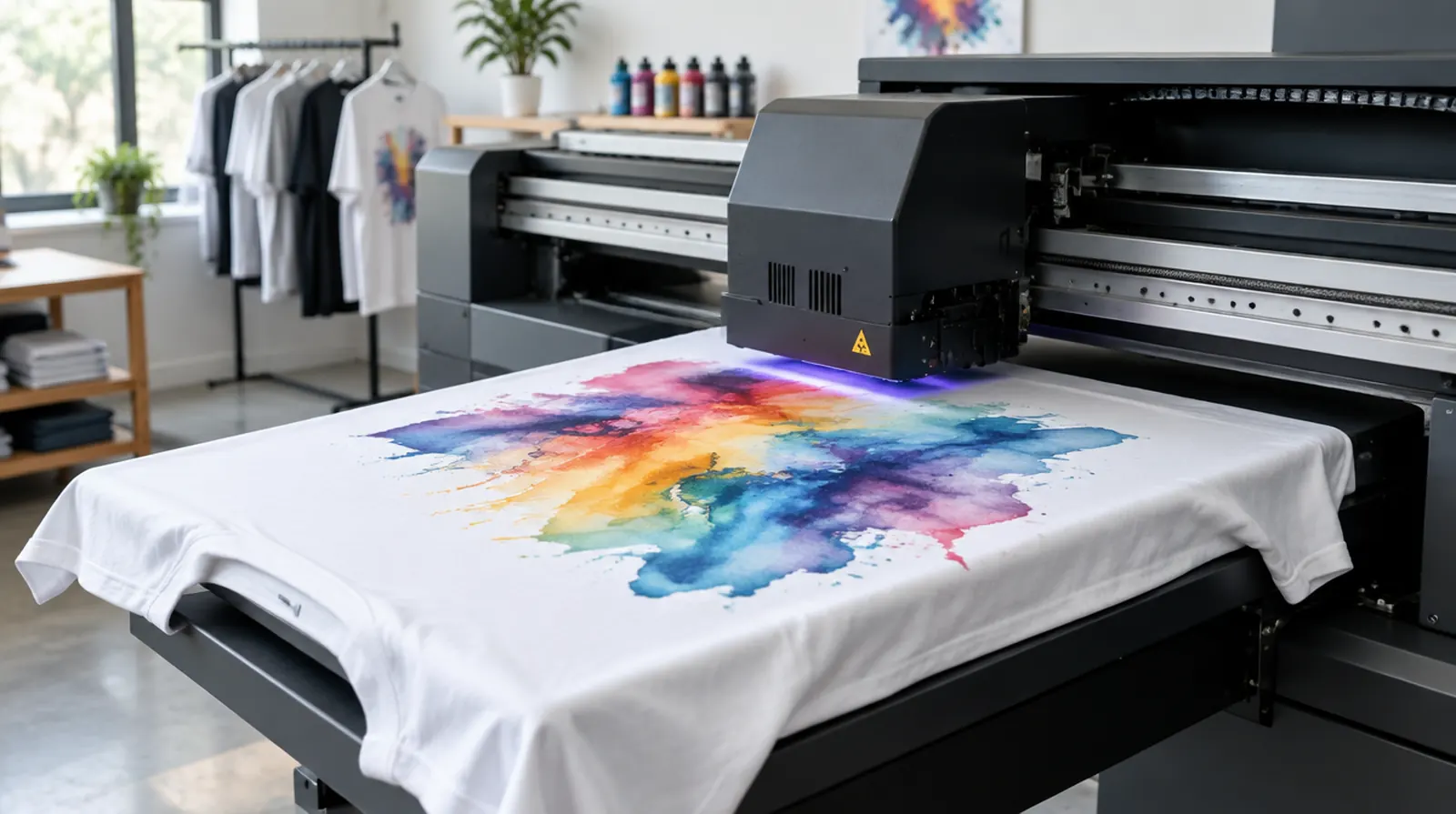
DTF means direct to film. The design is printed onto a clear film, coated with an adhesive powder and cured. The film is then laid on the garment and pressed with heat, and the design transfers onto the fabric. What you see on the shirt is a thin layer of printed film bonded to the surface.
Because the print is made on film first, it does not care much what the garment is made of. Cotton, polyester, blends and nylon all take it.
How does DTG work?
DTG means direct to garment. It is an inkjet printer built for clothing: the shirt is laid flat and the printer lays ink directly into the fibres, every colour in one pass. On a dark shirt, a white layer is printed first so the colours stay bright.
Because the ink goes into the fibre, DTG needs a fibre that takes it. That means cotton and high cotton blends.
DTF and DTG side by side
| DTF | DTG | |
|---|---|---|
| How | Printed on film, pressed on | Printed straight into the cotton |
| Fabrics | Cotton, polyester, blends, nylon | Cotton and high cotton blends |
| Feel | A thin smooth film you can feel | Almost nothing on light cotton |
| Dark garments | Bright, the film carries its own white | Needs a white underbase first |
| Fine lines, small text | Holds them well | Good, slightly heavier on dark shirts |
| Colours | Unlimited, no screens | Unlimited, no screens |
| Smallest order | One piece | One piece |
| Our price | By print size, from ₹50 | On the quote |
Which feels better on the shirt?
DTG, on cotton. The ink sits in the cloth rather than on it, so on a white or light t-shirt you barely feel the print. On a dark shirt the white underbase adds a soft layer you can feel slightly.
DTF always has a feel: a thin, smooth film on the surface. On a small chest logo nobody notices. On a large back print you will feel the edge of it with your hand.
Which works on polyester?
DTF. DTG ink needs cotton fibres to soak into, and on polyester the colours come out weak. DTF bonds to polyester and flexes with it, which is why it is common on jerseys, gym wear and the polyester Active Polo. For an all-over design on a polyester jersey, sublimation is the third option: the dye goes inside the fibre, edge to edge.
Which is better on a black t-shirt?
Both work, and they get there differently. DTG prints a white layer first, then the colour on top. It works well, but very fine detail reads slightly heavier than on a light shirt. DTF prints its own white behind the colours on the film, so a fine line on black stays a fine line. If the design is detailed and the shirt is dark, DTF is usually the safer choice.
Which holds fine detail and small text?
DTF holds fine detail and small text well, because the print is made on a flat film before it ever touches the fabric. That is why a logo with a small tagline under it stays readable. DTG is also good at detail on cotton, slightly less so on dark garments.
Which is cheaper?
For us, DTF has a published price by print size, per side, and it falls as the quantity rises:
| Print size | Up to | 1 to 9 pcs | 100+ pcs |
|---|---|---|---|
| A6 | 10.5 × 14.8 cm | ₹50 | ₹35 |
| A5 | 14.8 × 21 cm | ₹80 | ₹60 |
| A4 | 21 × 29.7 cm | ₹145 | ₹105 |
| A3 | 29.7 × 42 cm | ₹265 | ₹190 |
Add the garment: a Classic Crewneck is ₹415 at 1 to 9 pieces, so one t-shirt with an A6 chest print is ₹465, plus GST and shipping. DTG is priced on the quote for now, so ask for both if you are unsure and compare.
Which is faster?
DTF is part of our quickest tier: an order of up to 50 pieces in a core colour with matching parts, printed DTF or embroidered, is dispatched 4 days after you approve the mockup. For DTG, the date comes in writing with the mockup.
So which should I choose?
- Cotton tee, photo or soft gradient, light colour: DTG.
- Polyester, a blend, a jersey or a polo: DTF.
- Dark shirt, fine lines or small text: DTF.
- A price you can see before you ask: DTF, priced by size.
- Every shirt different, such as names: either. There is no screen to change between pieces.
- A large run of a simple one or two colour logo: neither. Screen printing is cheaper per piece; see screen printing or DTF and screen printing or DTG.
If you are not sure, send the design and the garment and we will tell you which we would use and why. The full list of methods, and how to choose between them, is in embroidery or print. To order, start on DTF printing, with a mockup before anything is printed.
Quick answers
What is the difference between DTF and DTG?
DTF prints the design on a film and presses it onto the garment, so it works on almost any fabric and leaves a thin film you can feel. DTG prints ink straight into cotton, so it feels like part of the shirt but needs cotton to work well.
Is DTF or DTG better for a cotton t-shirt?
DTG if you want nothing to feel on cotton, especially for a photo or a soft gradient on a light shirt. DTF if the design has fine detail or small text, or the shirt is dark.
Can DTG print on polyester?
Not well. DTG ink needs cotton to soak into, and on polyester the colours come out weak. Use DTF, or sublimation for an all-over design.
How much does a DTF print cost?
From ₹50 for an A6 print up to ₹265 for A3, per side, at 1 to 9 pieces, falling to ₹35 and ₹190 at 100 pieces and more. GST is added.
Can I order one DTF or DTG t-shirt?
Yes. Neither needs a screen, so one piece is a real order with either method.